Best Air Compressors 2026: Pancake, Portable, Quiet & Pro Picks
An air compressor is the workshop tool that unlocks the next tier of every other job: nail guns that drive 10 fasteners per second, spray finishes that come out flawless, impact wrenches that break loose lug nuts that resist all hand tools, and tire inflation that takes 30 seconds instead of 5 minutes. But buying the wrong compressor, a 6-gallon pancake for spray painting, or a 20-gallon wheeled tank when you only drive brads, means constant frustration instead of the tool doing its job.
The three specs that actually determine whether a compressor works for your applications are CFM (cubic feet per minute of sustained airflow), PSI (maximum pressure), and tank size (gallons). Peak horsepower is a stall-point marketing number that tells you nothing about real performance. This guide picks the right compressor for eight distinct real-world use cases, with honest tradeoff analysis for each.
At a Glance
 DEWALT Pancake Air Compressor, 6 Gallon, 165 PSI...
(I own this one; it has earned its spot.)
DEWALT Pancake Air Compressor, 6 Gallon, 165 PSI...
(I own this one; it has earned its spot.)
 Bostitch BTFP02012 0.8 HP 6 Gallon Oil-Free Pancake...
 California Air Tools 8010 1.0 HP Ultra Quiet and...
 Makita MAC700 2.0 HP* Big Bore™ Air Compressor
 DEWALT FLEXVOLT 60V MAX* Air Compressor Kit, Cordless,...
 California Air Tools 20020 2.0 HP Ultra Quiet and...
Product images and titles from Amazon. As an Amazon Associate we earn from qualifying purchases.
Quick Picks by Use Case
| Use case | Best Pick | Tank | Price range |
|---|---|---|---|
| Best overall | DeWalt DWFP55126 6-Gal. 165 PSI | 6 gal | $110–150 |
| Best budget | Bostitch BTFP02012 6-Gal. 150 PSI | 6 gal | $75–100 |
| Best ultra quiet | California Air Tools 8010 8-Gal. 60 dB | 8 gal | $185–230 |
| Best portable / rolling | Makita MAC700 Big Bore 2.6-Gal. | 2.6 gal | $200–260 |
| Best cordless | DeWalt DCC2560T1 FLEXVOLT 2.5-Gal. | 2.5 gal | $350–420 |
| Best for spray painting | California Air Tools 20020C 20-Gal. | 20 gal | $320–380 |
| Best mid-size value | Craftsman CMEC6150K 6-Gal. + Kit | 6 gal | $100–130 |
| Best pro 2-stage | Ingersoll Rand SS5L5 5HP 60-Gal. 2-Stage | 60 gal | $900–1,100 |
CFM, PSI & Tank Size: What Actually Matters
Most air compressor buyers fixate on peak horsepower and PSI, but those are the wrong specs. Here's what to actually match to your applications:
| Spec | What it means | Why it matters |
|---|---|---|
| CFM at 90 PSI | Cubic feet per minute of sustained airflow | Must exceed your tool's CFM requirement at the same PSI; this is the #1 spec to match |
| Max PSI | Peak pressure the tank holds | Nailers need 70–120 PSI; most 135+ PSI compressors are fine; only matters if you have specialty tools |
| Tank (gallons) | Air reservoir volume | Bigger tank = longer run time between motor cycles; critical for sustained-flow tools like spray guns |
| Noise (dB) | Sound level at rated load | Standard units: 79–85 dB (loud); quiet units: 60–70 dB (conversation level); major quality-of-life difference |
| Peak HP | Motor stall measurement | Marketing number only, ignore it |
CFM requirements by application
| Application | CFM needed at 90 PSI | Tank recommendation |
|---|---|---|
| Brad nailer / finish nailer | 0.3–1.0 CFM | Any 6-gal pancake |
| Framing nailer | 1.0–2.0 CFM | 6-gal pancake, recover time between shots |
| Tire inflation | 1–2 CFM at low PSI | Any compressor |
| Blow gun / blow-off | 1–3 CFM | 6-gal or larger |
| Air ratchet / impact wrench (light) | 3–5 CFM | 6-gal, allow recovery time |
| Orbital sander | 5–8 CFM | 15–20-gal minimum |
| HVLP spray gun | 6–12 CFM | 20-gal minimum; tank cycles will show in finish |
| Air grinder / die grinder | 5–8 CFM | 20-gal minimum for sustained use |
The 8 Best Air Compressors of 2026
DeWalt DWFP55126 6-Gallon 165 PSI Pancake Compressor
The DWFP55126 is the single most popular air compressor in the US for good reason: it hits all the right numbers for the most common homeowner and DIY applications at a price that doesn't require a second thought. The 165 PSI max pressure gives a substantial air reserve in a 6-gallon tank, more than the industry-standard 135 PSI, which means the motor cycles less frequently when you're nailing. At 2.6 SCFM at 90 PSI, it runs every common nailer (brad, finish, roofing, framing) without hesitation. The oil-free pump requires zero maintenance beyond keeping the filter clear. Startup time to working pressure from empty is around 2.5 minutes, and the 82 dB noise level is typical for the pancake class. The rubber feet are unusually grippy, the rubber-over-metal handle is comfortable, and the dual-regulated outlets let you run two tools at different PSIs simultaneously. DeWalt's parts and warranty support are the best in the category.
Pros
- 165 PSI (vs. 135 PSI standard) gives more reserve
- 2.6 SCFM at 90 PSI covers all nailers easily
- Zero maintenance oil-free pump
- Dual regulated outlets for two-tool use
- Excellent DeWalt warranty and parts availability
Cons
- 82 dB is typical but not quiet, wear ear protection indoors
- Too small for sustained spray painting or grinding
- Pancake profile stores flat but slightly less portable than hot-dog design
Bostitch BTFP02012 6-Gallon 150 PSI Oil-Free Pancake
The Bostitch BTFP02012 is the go-to budget pick that outperforms its price. At 2.6 SCFM at 90 PSI, it matches the DeWalt's airflow at a reliably lower street price. The 150 PSI max (versus DeWalt's 165 PSI) is a minor real-world difference for nailer work, the tank fills to 150 PSI and the regulator takes it down to your tool's 70–120 PSI working range, so you won't notice the gap driving nails. The oil-free pump is maintenance-free, and the 6-gallon tank is the right size for all pneumatic nailers. Noise at 82–83 dB is on par with the DeWalt. Stanley Black & Decker (Bostitch's parent) has solid warranty service. If the DeWalt is regularly out of stock or significantly more expensive, this is the buy without reservation.
Pros
- Consistently priced $20–40 below DeWalt equivalent
- 2.6 SCFM at 90 PSI, matches best-overall airflow
- Oil-free, zero maintenance
- 6-gal tank right-sized for all nailer work
Cons
- 150 PSI max (vs. 165 PSI on DeWalt), small real-world difference
- Single regulated outlet only
- Gauges are functional but less readable than DeWalt
California Air Tools CAT-8010 8-Gallon Ultra Quiet (60 dB)
California Air Tools built their business around one differentiated spec: noise level. The CAT-8010 runs at 60 dB, the level of a normal conversation, versus 79–85 dB for standard pancake compressors. The difference is enormous in practice. In an attached garage or basement workshop, 60 dB lets you hold a conversation, run the compressor without disturbing a sleeping child in the next room, and work for hours without hearing fatigue. The 8-gallon tank is 33% larger than a 6-gallon pancake, which means fewer motor cycles during extended nailing sessions. The oil-free dual-piston pump is engineered for quiet operation and rated for a long service life. At 2.2 SCFM at 90 PSI, airflow is slightly lower than the DeWalt (2.6 CFM) but more than adequate for all nailers and inflation work. If you use your compressor inside or near living space, the noise reduction is the single best upgrade you can make.
Pros
- 60 dB, dramatically quieter than any standard pancake
- 8-gallon tank means less frequent motor cycling
- Oil-free dual piston for long service life
- Works indoors, in apartments (check lease), garages next to living space
Cons
- 2.2 SCFM at 90 PSI (lower than standard pancakes at 2.6)
- $60–80 premium over comparable standard compressors
- Slower tank fill time due to quiet pump design
Makita MAC700 Big Bore 2.6-Gallon Oil-Lubricated Hot Dog
The MAC700 is the professional contractor's choice when the compressor has to travel daily. Its rolling tank design is more balanced and easier to carry than a pancake, and the big-bore cylinder and piston design deliver 3.3 SCFM at 90 PSI, the highest CFM output of any compressor in this size class. The oil-lubricated pump is the key differentiator: oil-bath lubrication runs cooler than oil-free designs, which means longer service life under continuous professional use. The trade-off is a required oil check before use (same as any oil-lubricated engine) and the compressor must be operated and stored upright. At 79 dB it's competitive with standard pancakes. The 2.6-gallon tank is smaller than a 6-gallon, which means more frequent cycling during framing sessions, but pros carry this compressor precisely because it's the smallest tank that generates enough CFM to keep up with a framing nailer in a professional workflow.
Pros
- 3.3 SCFM at 90 PSI, highest CFM in this portable class
- Oil-lubricated pump for longer service life under daily use
- Hot-dog rolling design easier to carry and maneuver
- Extremely popular with trim/finish carpenters on jobsites
Cons
- Requires periodic oil checks and changes
- Must stay upright, don't tip on its side in the truck bed
- 2.6-gallon tank cycles more frequently than 6-gal pancakes
- $200+ is a significant premium over oil-free pancakes
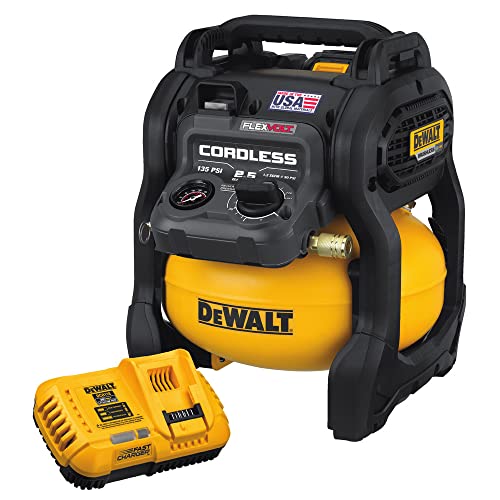
DeWalt DCC2560T1 FLEXVOLT 2.5-Gallon Cordless Air Compressor
For roofing, framing, and finish work in locations without power, the DeWalt FLEXVOLT cordless compressor eliminates the gas-powered compressor entirely. Running on DeWalt's 60V MAX FLEXVOLT battery, it delivers 2.5 SCFM at 90 PSI, enough for all nailer applications, without a power cord. The 2.5-gallon tank fills in about 70 seconds from empty. Battery life is the key variable: the included 7.5Ah FLEXVOLT battery drives approximately 1,200 brad nailer shots or 450 framing nailer shots per charge, which covers most single-day finish carpentry or roofing jobs. It works in 20V or 60V mode (60V FLEXVOLT battery required for full performance). If you're already in the DeWalt FLEXVOLT ecosystem, this is an easy addition. If you're not, factor in the battery ecosystem cost. The kit version (DCC2560T1) includes the battery and charger; the bare tool (DCC2560B) is substantially cheaper if you have batteries already.
Pros
- Fully cordless, works anywhere, no generator needed
- 2.5 SCFM at 90 PSI handles all nailers
- Fast fill: 70 sec to 165 PSI from empty
- Quiet operation (no gas engine)
- Bare tool (DCC2560B) significantly cheaper if you have FLEXVOLT batteries
Cons
- Limited shots per charge (1,200 brad / 450 framing) for full-day crews
- Kit price ($350–420) is a significant premium over corded pancakes
- Requires 60V MAX FLEXVOLT battery for full performance
California Air Tools CAT-20020C 20-Gallon Ultra Quiet
Spray painting demands sustained CFM output that small pancake compressors physically cannot deliver. The CAT-20020C solves both problems with a 20-gallon tank (giving the pump enough reserve that it doesn't cycle mid-stroke) and a dual-piston ultra-quiet motor running at 68 dB. At 5.3 SCFM at 90 PSI, double the output of a standard 6-gallon pancake, it can sustain an HVLP spray gun (typically requiring 5–10 CFM at 40 PSI) without pressure fluctuations that cause orange peel and runs. The ultra-quiet motor matters in spray painting because you typically run it for extended sessions in an enclosed space. Oil-free design means no risk of oil contamination in your air line reaching your finish. If you're spraying furniture, cabinets, automotive panels, or fences, this is the purpose-built tool for the job.
Pros
- 5.3 SCFM at 90 PSI sustains HVLP spray guns without cycling
- 20-gallon tank = consistent pressure through long spray sessions
- 68 dB ultra-quiet, tolerable for extended spray sessions
- Oil-free, no contamination risk for your finish coatings
Cons
- Large and heavy, not portable in the typical sense
- $320–380 is a significant step up from pancake compressors
- Overkill for nailer-only use
Craftsman CMEC6150K 6-Gallon Pancake Compressor Kit
The Craftsman CMEC6150K wins on value-for-first-kit: it bundles a capable 6-gallon 150 PSI compressor with 13 accessories (air hose, blow gun, chuck, couplers, plugs, and inflation tips) at a total price that's often less than buying the compressor alone elsewhere. At 2.6 SCFM at 90 PSI, performance is on par with the DeWalt and Bostitch. The kit makes it the obvious choice for someone buying their first air compressor who doesn't already have any accessories, you're set up and inflating tires or nailing trim the day the box arrives. Craftsman's parent (Stanley Black & Decker) provides solid warranty service. The compressor itself is straightforward and reliable; it's not the quietest or highest-spec in the category but it covers the most common homeowner use cases right out of the box.
Pros
- 13-piece accessory kit included, ready to use out of the box
- 2.6 SCFM at 90 PSI matches best-overall performance
- Great total value for first-time buyers
- Oil-free, maintenance-free pump
Cons
- Kit accessories are entry-level; upgrade the hose eventually
- 150 PSI max (same as Bostitch, vs. 165 PSI DeWalt)
- Slightly noisier than DeWalt at the same settings
Ingersoll Rand SS5L5 5HP 60-Gallon 2-Stage Compressor
Two-stage compressors compress air twice, first to 90 PSI, then a second cylinder compresses the 90 PSI air up to 175+ PSI. The result is significantly more efficient operation and the ability to deliver sustained high-CFM output to multiple tools simultaneously. The Ingersoll Rand SS5L5 is the professional shop standard: a 175 PSI max, 13.5 SCFM at 90 PSI two-stage belt-drive compressor on a 60-gallon vertical tank. At 13.5 CFM, it can simultaneously run a spray gun, a DA sander, and an impact wrench and not break a sweat. The cast-iron pump is designed for 10,000+ hours of service with regular oil changes. This is the correct compressor for a professional body shop, cabinet shop, auto garage, or any scenario where air tools run all day, every day. It requires 240V single-phase power (standard for dedicated shop circuits); it's not a plug-into-the-wall unit.
Pros
- 13.5 SCFM at 90 PSI, runs multiple tools simultaneously
- Two-stage compression delivers 175 PSI with high efficiency
- Cast-iron pump rated for 10,000+ service hours
- 60-gallon tank means almost no cycling during sustained use
- Ingersoll Rand is the definitive professional compressor brand
Cons
- Requires 240V dedicated circuit, not plug-in ready
- $900–1,100 price; professional-grade investment
- Large and heavy, not movable without equipment
- Oil-lubricated: requires regular oil changes
Essential Accessories
A bare compressor without the right accessories is half a tool. Every air compressor setup needs:
- Air hose (50 ft hybrid): 50-ft hybrid hose, stays flexible in cold weather, doesn't kink like rubber, lighter than PVC. Get at least 25 ft; 50 ft is standard for most garage setups.
- Air hose reel (retractable): Wall-mount retractable reel, keeps your floor clear and the hose off the ground; the single best organizational upgrade for a dedicated workshop compressor.
- Quick-connect coupler set: Industrial coupler + plug kit, lets you swap tools in one click without threading fittings each time. Industrial (4-jaw) and automotive (ARO) styles don't interchange; pick one and standardize all your tools to it.
- Inline water separator / filter: Inline water separator, critical for spray painting and any use where moisture contamination ruins your work. Air compressors generate condensation as a byproduct of compression; this catches it before it reaches your tool.
- Drain valve (automatic): Auto-drain valve, the most neglected maintenance item; accumulated tank water causes rust and tank failure. Either drain manually after every use or install an auto-drain that opens briefly each time the compressor shuts off.
- Inflation kit with gauge: Inflation kit + chuck, Presta/Schrader/sports ball adapters and a dial gauge; the kit form is better than buying individual pieces.
Which Air Compressor Should You Buy?
Three questions narrow it down:
- Will you spray paint or run sustained-flow tools (sanders, grinders)? If yes, you need the 20-gallon California Air Tools (or larger). Skip the pancakes entirely for this application.
- Do you need to carry the compressor to different locations daily? If yes and you have 240V power available, the Makita MAC700's high CFM-per-pound is the contractor's choice. If you have no power, the DeWalt FLEXVOLT cordless is the answer.
- Are you nailing in an attached garage, basement, or shared wall? If yes, the California Air Tools ultra-quiet models are worth the price premium over the 25 dB noise reduction they deliver.
If none of the above applies: the DeWalt DWFP55126 is the right all-around choice for most homeowners and DIYers.
Frequently Asked Questions
What PSI do I need for air tools and nailers?
Most air nailers run at 70–120 PSI, and any 6-gallon pancake rated 135+ PSI handles them easily. The more important spec is CFM, not PSI, your compressor's CFM at 90 PSI must exceed your tool's CFM requirement.
What size tank (gallons) do I need?
For nailers (short air bursts): a 6-gallon pancake. For spray guns, sanders, grinders, and sustained-airflow tools: 20-gallon minimum. The motor cycling mid-stroke on a small tank shows up directly in your finish quality.
Oil-free vs. oil-lubricated: which lasts longer?
Oil-lubricated pumps (like the Makita MAC700) last longer under daily professional use. Oil-free is the right choice for homeowners and DIYers: maintenance-free, portable, no contamination risk for spray finishing, and adequate service life for light-to-moderate use.
Can I use a 6-gallon pancake for spray painting?
For touch-ups under 2 sq ft, technically yes. For any real spray project, no, the motor will cycle every 30–45 seconds and the pressure fluctuation will ruin the finish. Get a 20-gallon compressor for spray work.
How loud are air compressors, and does it matter?
Standard pancakes run 79–85 dB (loud but not dangerous for short sessions). California Air Tools' quiet line runs 60–70 dB, a conversation-level difference. If your compressor is in or near living space, the noise reduction is worth the price premium.
See also: Best Cordless Drills 2026, Best Impact Drivers 2026, Best Shop Vacuums 2026