Best Miter Saws 2026: Tested by Use Case
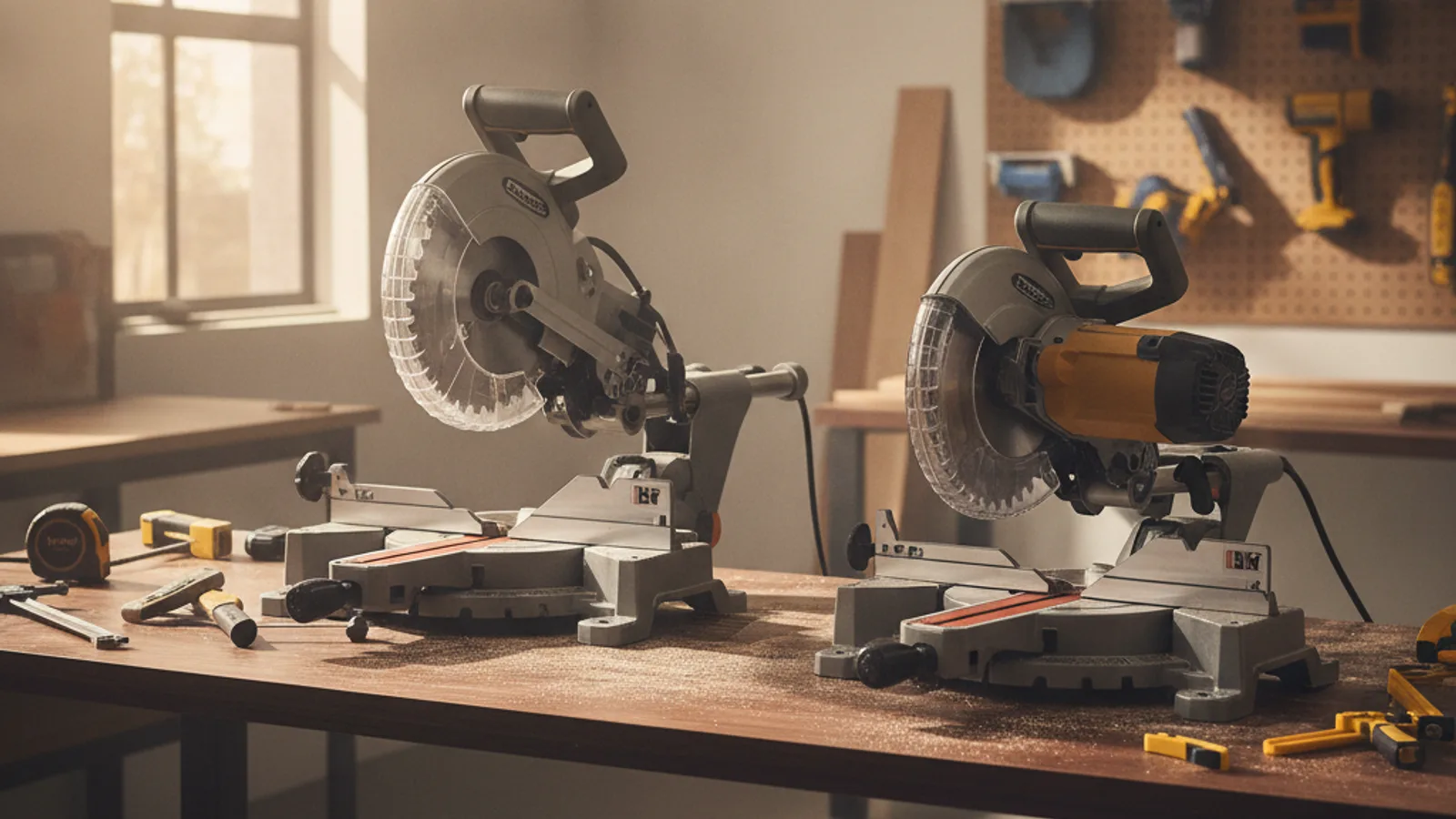
A miter saw is the tool that makes trim carpentry, decking, and framing look professional. The crosscut accuracy and repeatable angle stops are what separate a miter saw from a circular saw for this work, you set 45° once and cut a hundred identical pieces without measuring each one. Modern compound miter saws add bevel cuts, letting you cut crown molding and complex trim profiles in a single pass.
The right saw depends on three questions: how wide a board do you need to cut, whether you need bevel cuts on both sides, and whether cordless matters. This guide answers all three and gives you a concrete pick for every real use case.
At a Glance
 DEWALT Miter Saw, 12 Inch Double Bevel Sliding...
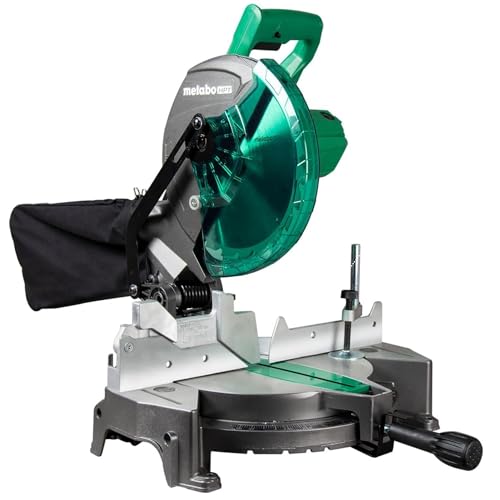 Metabo HPT 10-Inch Compound Miter Saw, 15-Amp, Single...
 Makita LS1019L 10" Dual-Bevel Sliding Compound Miter...
 BOSCH GCM12SD 12 In. Dual-Bevel Glide Sliding Compound...
 DEWALT 12-Inch Miter Saw, 15-Amp, Single Bevel,...
 RIDGID 15 Amp 12 in. Corded Dual Bevel Sliding Miter...
Product images and titles from Amazon. As an Amazon Associate we earn from qualifying purchases.
Quick Picks by Use Case
| Use case | Best Pick | Why | Price |
|---|---|---|---|
| Best overall | DeWalt DWS779 12" Sliding Compound | Handles 2x12 crosscuts, crown molding, dual bevel | $400–500 |
| Best budget | Metabo HPT C10FCGS 10" Compound | 24.9 lbs, accurate detents, great for DIY trim | $160–200 |
| Best 10" sliding | Makita LS1019L 10" Dual-Bevel Sliding | Compact footprint, laser guide, 13.5" crosscut capacity | $550–650 |
| Best cordless | Milwaukee M18 FUEL 2739-20 12" Sliding | No cord, full-power cuts, 6,000 RPM | $570–650 (bare) |
| Best budget cordless | Ryobi PCL551B ONE+ 10" Sliding | ONE+ ecosystem, 2x8 capacity, battery included in kit | $230–310 |
| Best for pros | Bosch GCM12SD 12" Axial-Glide | No rear clearance needed, dual bevel, 14" crosscut | $550–700 |
| Best lightweight/shop | DeWalt DWS715 12" Single-Bevel Compound | Non-sliding, lightest 12" option, accurate stall guards | $250–350 |
| Best value 12" sliding | Ridgid R4221 12" Dual-Bevel Sliding | Lifetime service agreement, 14" crosscut, lower cost than DeWalt | $280–380 |
10-Inch vs. 12-Inch, Sliding vs. Non-Sliding Decision Table
| Scenario | Best choice |
|---|---|
| Trim work, 2x4 framing, deck boards | 10" compound (non-sliding saves money) |
| Crown molding, wide boards up to 2x10 | 10" sliding compound |
| 2x12 dimensional lumber, 4x4 posts | 12" sliding compound |
| Same-direction compound angles (crown flat) | Single bevel works fine |
| Both-direction compound cuts without flipping | Dual bevel required |
| Job site / no power available | Cordless (Milwaukee or Ryobi) |
| Small shop, limited wall clearance | Bosch Axial-Glide (no rear clearance needed) |
| Budget: occasional use | Metabo HPT C10FCGS |
Best Overall Miter Saw
DeWalt DWS779 12" Sliding Compound Miter Saw
15A motor · 3,800 RPM · 0–48° dual bevel · 2x12 crosscut capacity
The DWS779 is the miter saw that consistently tops every contractor's and serious DIYer's list, and for good reason: it cuts accurately out of the box, handles everything from 2x4 framing to wide crown molding, and the 15-amp motor pushes through hardwood without bogging. DeWalt's exclusive stainless steel miter detent plate has 11 positive stops, including the common 22.5° and 31.6° crown molding angles, with a cam lock that locks tight without wobble.
The dual-bevel head tilts 0–48° left and right, so you can set up both sides of a crown molding cut without flipping the board. The horizontal handle design keeps your wrist in a neutral position for long days of cutting. DeWalt includes a dust bag (not a port, an actual bag), a work light, and a material clamp. The XPS LED line indicator that comes on the step-up DWS780 is not on the DWS779, you use a shadow line, but at this price tier it's a non-issue for accuracy.
Pros
- Crosscuts full 2x12 dimensional lumber and 14" boards
- 11-position stainless detent plate with cam lock
- Dual bevel 0–48° left and right
- 15A motor handles hardwood without bogging
- 3-year warranty, DeWalt service network everywhere
Cons
- No XPS LED line indicator (upgrade to DWS780 for that)
- Requires ~20" of rear clearance for the rails to slide
- Heavy at 56 lbs, not a saw to carry up stairs daily
Best Budget Miter Saw
Metabo HPT C10FCGS 10" Compound Miter Saw
15A motor · 5,000 RPM · 0–45° bevel (single) · 24.9 lbs
At just 24.9 lbs and under $200, the Metabo HPT C10FCGS punches well above its price. It's a single-bevel (tilts left only) 10" non-sliding saw, which means the crosscut capacity tops out around 8 inches at 90°, enough for 2x4, 2x6, 2x8, and most trim profiles. What it delivers is a fast 5,000 RPM motor that zips through pine, poplar, and oak trim without hesitation, and a lightweight chassis that makes it easy to move to where the work is.
The positive miter stops at 0°, 15°, 22.5°, 31.6°, and 45° left and right are accurate and lock firmly. If you're building a deck, installing baseboard, cutting door casing, or framing a wall, this saw does it cleanly. Its limitation is the bevel: if you ever need compound angle cuts on both sides, you'll flip the board, livable for occasional projects, annoying for a full trim package.
Pros
- Extremely lightweight (24.9 lbs) for a 15A saw
- 5,000 RPM for faster cuts in hardwood
- Accurate detent positions straight from the box
- Most affordable saw on this list
- 5-year limited warranty
Cons
- Single bevel only, no right-tilt for compound cuts
- No sliding mechanism, limited to ~8" crosscut width
- Basic dust collection (bag, not port)
Best 10-Inch Sliding Miter Saw
Makita LS1019L 10" Dual-Bevel Sliding Compound
15A motor · 4,400 RPM · 0–48° dual bevel · 13.5" crosscut · Laser guide
The LS1019L is Makita's answer to the challenge of building a 10" sliding saw that's actually compact. Most sliding saws require 12–20 inches of rear clearance for the rails, the LS1019L uses a two-steel-rail design that folds when closed, reducing the footprint enough to fit against a wall in a tight shop. Despite the 10" blade, it achieves a 13.5" crosscut capacity at 90°, which covers 2x10 framing lumber and most wide moldings.
The dual-bevel system tilts 0–48° left and 0–5° right, covering all standard compound angle cuts. The integrated laser guide (the "L" in LS1019L) projects a cut line so you can see exactly where the blade will land before the cut, useful for fine trim work. The electric brake stops the blade in under 2 seconds after releasing the trigger.
Pros
- Compact sliding rail system reduces rear wall clearance needed
- 13.5" crosscut capacity from a 10" blade
- Dual bevel 0–48° left, 0–5° right
- Integrated laser guide for precision cuts
- Electric brake, blade stops in <2 seconds
Cons
- Premium price for a 10" saw
- Right bevel limited to 5° (vs 48° on left)
- Heavier than non-sliding options at 55 lbs
Best Cordless Miter Saw
Milwaukee M18 FUEL 2739-20 12" Dual-Bevel Sliding
M18 FUEL motor · 6,000 RPM · 0–48° dual bevel · 12" crosscut · No cord
Milwaukee's M18 FUEL miter saw solves the only real complaint about cordless saws, power. The POWERSTATE brushless motor spins at 6,000 RPM (faster than most corded competitors) and delivers consistent torque from first cut to last board, regardless of how much charge is left on the battery. A 12Ah M18 HIGH OUTPUT battery delivers over 500 cuts in 2x4 pine per charge, enough for a full day of framing or a major trim package.
The dual-bevel sliding head covers 0–48° in both directions, and the 12" crosscut capacity handles 2x10 and wide baseboard. The saw includes Milwaukee's integrated LED shadow cut line, so you see the exact kerf position before cutting. No laser to calibrate, no battery to replace, just a shadow that's always accurate. This is the saw finish carpenters and trim crews reach for when they want to stop dragging cords across a job site.
Pros
- 6,000 RPM, faster than most corded competitors
- No cord: works anywhere, no extension cord trip hazard
- LED shadow cut line, never needs calibrating
- Dual bevel 0–48° both directions
- M18 ecosystem, 250+ compatible tools share batteries
Cons
- Bare tool only, 12Ah battery adds $100-150
- Heavier than corded: 57.2 lbs without battery
- Premium price vs. corded equivalent
Best Budget Cordless Miter Saw
Ryobi PCL551B ONE+ 18V 10" Sliding Compound
18V brushless · 5,200 RPM · Single bevel · 2x8 crosscut · ONE+ compatible
If you already own Ryobi ONE+ tools, and millions of homeowners do, the PCL551B is the most cost-effective way to add a miter saw to your kit. Powered by any 18V ONE+ battery, the brushless motor delivers 5,200 RPM and handles all the cuts a homeowner needs: baseboard, door casing, deck boards, and basic framing. The sliding mechanism extends crosscut capacity to 2x8 lumber at 90°, which covers the vast majority of residential trim work.
The limitations are real but manageable: single bevel (tilts left only, no right tilt), and battery runtime is shorter than a 40V or M18 FUEL system. A 4Ah ONE+ battery yields about 150–200 cuts in 2x4 pine. For weekend projects, that's plenty. The saw is lightweight at 35 lbs and sets up in 30 seconds wherever you need it.
Pros
- Compatible with all 300+ Ryobi ONE+ 18V tools and batteries
- Lightweight (35 lbs) and easy to move
- Brushless motor for longer battery life
- Low entry cost if already in ONE+ ecosystem
Cons
- Single bevel only, can't tilt right
- Shorter runtime than 40V or M18/FLEXVOLT systems
- Crosscut limited to 2x8 at 90°
Best Professional Miter Saw
Bosch GCM12SD 12" Dual-Bevel Axial-Glide
15A motor · 3,800 RPM · 0–47° dual bevel · 14" crosscut · No rear clearance needed
The GCM12SD's Axial-Glide system replaces the traditional sliding rails with an articulating arm that folds up behind the head when closed. This solves a real problem for finish carpenters: you can push this saw against a wall and still use the full sliding range. Traditional sliding saws need 12–20 inches of rear clearance; the GCM12SD needs zero.
The 14" crosscut capacity at 90°, the largest on this list, handles 4x4 posts, wide crown molding, and 2x12 dimensional lumber with room to spare. The dual-bevel head tilts 0–47° left and right. Bosch includes a squaring jig for easy recalibration and a dust port that actually captures a high percentage of the cut debris. This is the saw that professional trim carpenters choose when they're setting up a permanent shop or a recurring job site.
Pros
- No rear clearance needed, push against any wall
- Largest crosscut capacity (14") on this list
- Dual bevel 0–47° both directions
- High dust capture rate with dust port
- Squaring jig included for easy recalibration
Cons
- Highest price of corded options on this list
- Heavy at 65.3 lbs, not a portable saw
- Overkill for occasional homeowner use
Best Lightweight Shop Saw
DeWalt DWS715 12" Single-Bevel Compound Miter Saw
15A motor · 4,000 RPM · Single bevel · 2x14 crosscut · 42 lbs
The DWS715 is DeWalt's non-sliding 12" saw: lighter than any 12" slider at 42 lbs, and able to crosscut a full 2x14 at 90° because it has no rail limitations. Non-sliding is sometimes misread as a downgrade, but for crosscuts on a workbench or permanent shop stand, the non-sliding design is actually stiffer and more repeatable, there's no play in rails to affect accuracy.
It's a single-bevel saw, meaning it tilts only left (0–48°). For straightforward crosscuts, basic miter cuts, and one-direction bevel work (most baseboard and casing), this is all you need. The DWS715 is the quiet workhorse saw for a shop that does more crosscutting than compound angle trim work.
Pros
- Lightest 12" option at 42 lbs
- 2x14 crosscut capacity, more than most 12" sliders
- No rear clearance needed (non-sliding)
- More rigid than sliding saws (no rail play)
- Lower price than equivalent sliding models
Cons
- Single bevel only
- Non-sliding limits use for very wide boards at angles
- No laser or shadow line indicator included
Best Value 12-Inch Sliding Miter Saw
Ridgid R4221 12" Dual-Bevel Sliding Miter Saw
15A motor · 3,200 RPM · 0–45° dual bevel · 14" crosscut · Lifetime service
Ridgid's R4221 occupies the gap between budget saws and premium brands: it's a 12" dual-bevel sliding saw that cuts a full 14" board at 90°, runs on a 15A motor, and comes with Ridgid's Lifetime Service Agreement (LSA), free parts and service for as long as you own it, with registration. No comparable saw from DeWalt or Makita at this price includes a lifetime service deal.
The dual-bevel head goes 0–45° both directions (vs. the DWS779's 48°), which covers every standard cut. The sliding rails require rear clearance like other traditional sliding designs. Where the R4221 shows its value-tier roots is fit and finish, the material clamp is basic, the dust collection is average, and the fence isn't as precisely machined as a Bosch or Makita. But for general framing, rough carpentry, and homeowners who want maximum cut capacity without paying DeWalt prices, the LSA makes it a compelling long-term buy.
Pros
- Lifetime Service Agreement (free parts/service, registered)
- 14" crosscut capacity at a lower price than DeWalt
- Dual bevel 0–45° both directions
- Wide availability at Home Depot for service
Cons
- 3,200 RPM is slower than competitors (DWS779: 3,800; LS1019L: 4,400)
- Fit and finish below DeWalt/Bosch level
- Requires rear clearance like all traditional sliding saws
Miter Saw Accessories Worth Buying
- Miter saw stand with rollers, Most important accessory after the saw. A stand with extension rollers lets you support long boards without a helper. DeWalt, Bosch, and Ridgid all make stands with quick-clamp mounts for their saws.
- 80-tooth ATB finish blade, Replace the general-purpose blade that ships with the saw before any trim or finish work. The 80-tooth alternate top bevel grind leaves a glass-smooth surface on hardwood and plywood.
- Freud Diablo blade set, Freud Diablo makes the best-reviewed aftermarket blades at reasonable prices, a 60-tooth for general cutting and an 80-tooth for finish work covers all use cases.
- Digital angle gauge, A digital angle gauge (also called a digital protractor) reads the exact angle of existing trim so you can match it perfectly when replacing or extending. Saves multiple test cuts.
- Stop block clamp, A fence-mounted stop block lets you cut identical lengths without measuring each piece. Essential for any repetitive cutting like stair risers, shelf brackets, or deck boards.
- Dust deputy separator, Even with a dust bag, miter saws generate significant fine dust. A cyclone separator between the saw's dust port and a shop vac catches 99% of particulate before it reaches the vac filter.
- Anti-fog safety glasses, Miter saws throw chips toward the operator. Anti-fog glasses mean you don't take them off in warm conditions, which is when injuries happen.
Frequently Asked Questions
What size miter saw should I buy, 10-inch or 12-inch?
For most homeowners and DIYers: a 10-inch miter saw handles all standard lumber, trim, and deck boards and is lighter and cheaper. Upgrade to 12-inch only if you regularly cut 4x4 posts or 2x12 dimensional lumber. A 10-inch sliding saw out-crosscuts a 12-inch non-sliding saw in most scenarios.
What is the difference between a compound and sliding compound miter saw?
A compound saw adds bevel (tilt) cuts to the standard miter angle. A sliding compound saw adds rails so the head slides forward, dramatically increasing crosscut width. If you plan to cut boards wider than a 2x6, the sliding mechanism is the most important upgrade.
Do I need single or dual bevel?
Dual bevel tilts both left and right, so you can cut compound angles on both sides without flipping the board. For trim work and crown molding, dual bevel saves significant time. For basic crosscuts and simple 45° miters, single bevel is fine and costs less.
Are cordless miter saws worth it?
Yes, for job sites, outdoor work, or moving frequently between rooms. The Milwaukee M18 FUEL and DeWalt FLEXVOLT deliver power comparable to corded saws for most cuts. If you always work near power, a corded saw is lighter, cheaper, and runs indefinitely.
What miter saw blade should I use for trim work?
An 80-tooth ATB (alternate top bevel) blade produces glass-smooth finish cuts. Replace the 24–40 tooth general-purpose blade that ships with most saws before any finish carpentry. Keep the original blade for rough cuts to save the finish blade's edge.
Related: Best Cordless Drills 2026 · Best Impact Drivers 2026 · Best Laser Levels 2026