How Many Tiles Do I Need?
· By DIY Calc
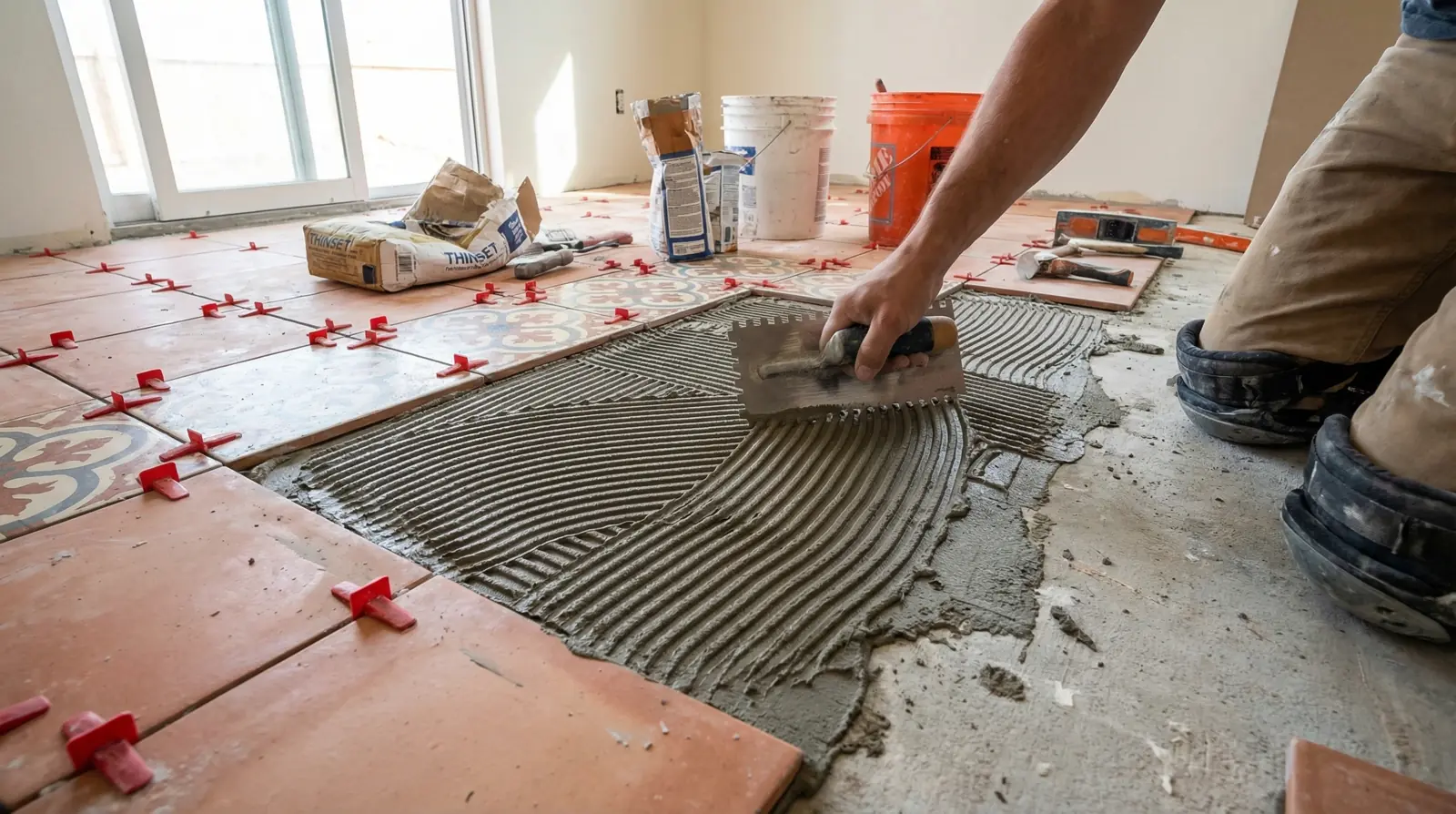
Quick answer: Divide your total square footage by the area of one tile (in square feet), then add 10–20% for waste depending on your pattern. A 120 sq ft room with 12×12 tiles needs about 132 tiles (with 10% waste).
Skip the math, use our free Tile Calculator →
The Basic Formula
Calculating tile quantity is straightforward once you know the steps:
- Measure your area, length × width in feet to get square footage
- Calculate tile area, convert tile dimensions to feet (e.g., 12×12 in = 1×1 ft = 1 sq ft per tile)
- Divide, total square footage ÷ tile area = number of tiles
- Add waste, multiply by 1.10 for straight, 1.15 for diagonal, 1.20 for herringbone
- Round up to full boxes
Example: 10×12 Bathroom Floor with 12×24 Tiles
Area: 10 × 12 = 120 sq ft
Tile area: 12×24 inches = 1 × 2 ft = 2 sq ft per tile
Base tiles: 120 ÷ 2 = 60 tiles
With 10% waste: 60 × 1.10 = 66 tiles
At 6 tiles per box: 11 boxes
Why Pattern Matters for Waste
The pattern you choose significantly affects how many tiles you'll cut and waste.
Straight/grid pattern is the most efficient. Cuts along walls are simple straight lines, and offcuts from one side can sometimes be used on the other. Plan for 10% waste.
Diagonal (45°) pattern looks great but every wall edge requires an angled cut. Very few offcuts are reusable. Budget 15% waste minimum.
Herringbone pattern creates the most waste because every edge requires precise angled cuts, and the interlocking pattern makes offcut reuse nearly impossible. Plan for 18–20% waste.
Don't Forget the Grout Gap
Grout gaps slightly reduce the effective coverage of each tile. Standard gaps are:
- 1/16", Rectified (precision-cut) tiles only
- 1/8", Most common for rectified tiles
- 3/16", Standard for non-rectified tiles
- 1/4", Natural stone and rustic looks
For most installations, grout gaps add less than 2% to your tile count, but our calculator accounts for it precisely.
Adhesive and Grout Quantities
Thinset mortar: One 50-lb bag covers approximately 50 square feet with a standard 1/4" square-notch trowel. Larger format tiles (12×24 and up) need a larger trowel and more thinset.
Grout: The amount depends on tile size and gap width. Larger gaps and smaller tiles use more grout. A 25-lb bag of sanded grout covers roughly 100–200 sq ft depending on tile size and joint width.
Pro Tips for Buying Tile
- Same dye lot: Always buy all your tile at once from the same lot. Different production runs can have noticeable color variation.
- Keep extras: Store 5% of your tiles after installation. If you need to replace a cracked tile in 3 years, matching tiles from the same lot will be impossible to find.
- Check for flatness: Stack a few tiles face-to-face. Any lippage or warping means difficult installation and visible edges.
- Buy quality underlayment: The substrate matters more than the tile. Uncoupling membrane (like Ditra) prevents cracked tiles from subfloor movement.
Common Tile Sizes
- 6×6", 0.25 sq ft, Traditional, great for backsplashes
- 12×12", 1.0 sq ft, Classic floor tile
- 12×24", 2.0 sq ft, Modern, fewer grout lines
- 6×24", 1.0 sq ft, Wood-look plank tile
- 24×24", 4.0 sq ft, Large format, spacious look