How Much Deck Stain Do I Need?
· By DIY Calc
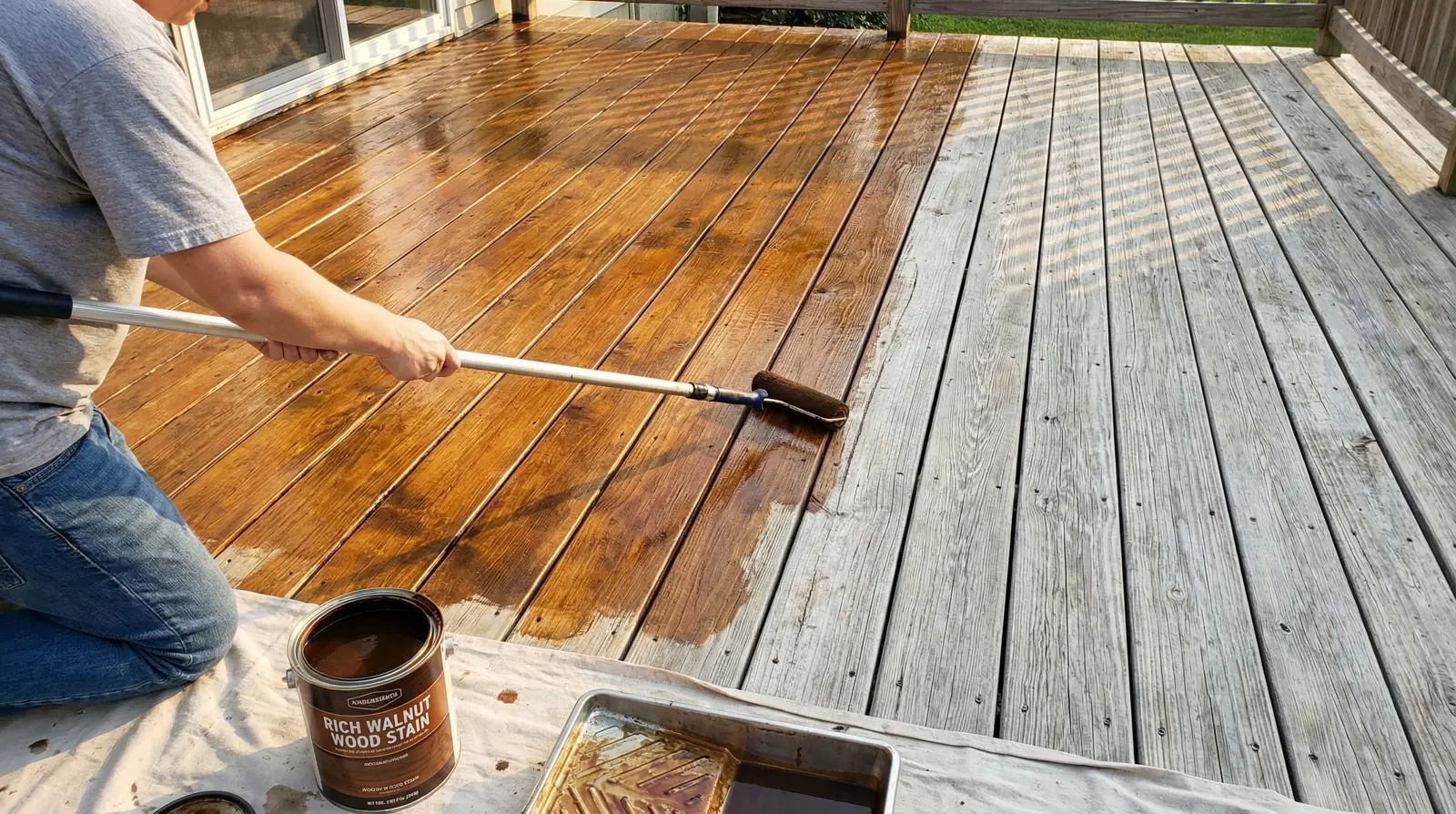
Quick answer: Divide your deck's total square footage by the stain's coverage rate, then multiply by the number of coats. A 300 sq ft deck with 2 coats of semi-transparent stain needs about 2.5 gallons. Coverage varies by stain type: transparent covers ~300 sq ft/gal, semi-transparent ~250 sq ft/gal, and solid ~200 sq ft/gal.
Skip the math, use our free Deck Stain Calculator →
The Formula
Calculating deck stain is simpler than most DIY material estimates:
- Measure your deck, length × width in feet to get square footage
- Choose your stain type, this determines coverage rate
- Divide by coverage rate, sq ft ÷ coverage rate = gallons per coat
- Multiply by coats, usually 2 coats for best protection
- Round up, always buy whole gallons
Coverage Rates by Stain Type
Not all stains cover the same area. The more pigment in the stain, the thicker the film, and the less area a gallon covers:
- Transparent (clear) stain: ~300 sq ft per gallon, thinnest film, shows full wood grain, needs reapplication every 1-2 years
- Semi-transparent stain: ~250 sq ft per gallon, adds color while showing grain, lasts 2-3 years
- Solid stain: ~200 sq ft per gallon, full color coverage like paint, hides grain, lasts 3-5 years
These rates assume smooth, previously sealed wood. Rough-sawn or weathered wood absorbs 20-30% more stain, so reduce your expected coverage accordingly.
Real-World Examples
Example 1: Standard Backyard Deck
A 12 ft × 16 ft deck (192 sq ft) with 2 coats of semi-transparent stain:
- 192 sq ft × 2 coats = 384 sq ft total coverage
- 384 ÷ 250 = 1.54 gallons
- Round up: 2 gallons
Example 2: Large Multi-Level Deck
A 500 sq ft deck with railings (add ~50 sq ft for railing surfaces), 2 coats of solid stain:
- 550 sq ft × 2 coats = 1,100 sq ft total
- 1,100 ÷ 200 = 5.5 gallons
- Round up: 6 gallons
Example 3: Small Front Porch
An 8 ft × 6 ft porch (48 sq ft) with 2 coats of transparent stain:
- 48 sq ft × 2 coats = 96 sq ft total
- 96 ÷ 300 = 0.32 gallons
- 1 gallon is plenty (with leftover for touch-ups)
Don't Forget the Railings
Deck railings add significant surface area that's easy to overlook. As a rule of thumb:
- Standard railing section (8 ft): ~16-20 sq ft of stainable surface (posts, top rail, balusters)
- Add 10-15% to your deck sq ft if you're staining railings too
- Railings have many edges and corners that absorb more stain than flat surfaces
Prep Work: The Key to a Great Finish
The biggest mistake DIYers make isn't buying the wrong amount of stain, it's skipping prep. Proper preparation makes the difference between a finish that lasts 1 year and one that lasts 5.
Step 1: Clean the Deck
Power wash at 1,500-2,000 PSI (use a fan tip, not a zero-degree nozzle). Hold the wand 6-8 inches from the surface and work with the grain. For stubborn stains, use a deck cleaner/brightener first.
Step 2: Let It Dry
Wait 24-48 hours after power washing. The wood should be completely dry, check by sprinkling water on the surface. If it soaks in immediately, you're good. If it beads up, wait longer.
Step 3: Sand If Needed
If the old finish is peeling or rough, sand with 60-80 grit to remove the old coating. For smooth wood that just needs refreshing, 80-100 grit is fine. Always sand with the grain.
Step 4: Remove Dust
Blow or sweep all sanding dust off the deck. Any dust left on the surface gets trapped under the stain and looks terrible.
Weather Conditions for Staining
Timing your stain application is just as important as choosing the right product:
- Temperature: 50-90°F is the safe range. 60-80°F is ideal.
- Humidity: Below 50% is best. High humidity slows drying and can cause blotching.
- Rain: No rain in the forecast for at least 24 hours (48 hours for oil-based stains).
- Sunlight: Avoid staining in direct sun. The stain dries on the surface before it can penetrate the wood. Stain in the shade, or work early morning/late afternoon.
- Wind: Light breeze is fine and helps drying. Heavy wind carries debris onto wet stain.
Oil-Based vs. Water-Based Stain
Both work well, but they have different characteristics:
Oil-based stains penetrate deeper, last longer, and enhance the natural wood grain. They take longer to dry (24+ hours between coats), have stronger fumes, and require mineral spirits for cleanup. Best for horizontal surfaces that take heavy foot traffic.
Water-based stains dry faster (2-4 hours between coats), clean up with water, and have lower VOCs. They sit more on the surface, may peel over time on horizontal surfaces, but work great on vertical surfaces like railings and siding.
How Often Should You Re-Stain?
- Transparent: Every 1-2 years
- Semi-transparent: Every 2-3 years
- Solid: Every 3-5 years
Do the water test annually: splash some water on your deck. If it beads up, the stain is still protecting. If it soaks in, it's time to re-stain.
Common Mistakes
- Staining wet wood, the stain won't penetrate and will peel within months
- Applying too thick, leads to a sticky, tacky finish that never fully cures
- Not back-brushing, if using a sprayer, always go back with a brush to work the stain into the grain
- Buying the wrong amount, running out mid-project means different batches that may not match perfectly
- Staining new pressure-treated wood, it needs 3-6 months to dry out before it'll accept stain